


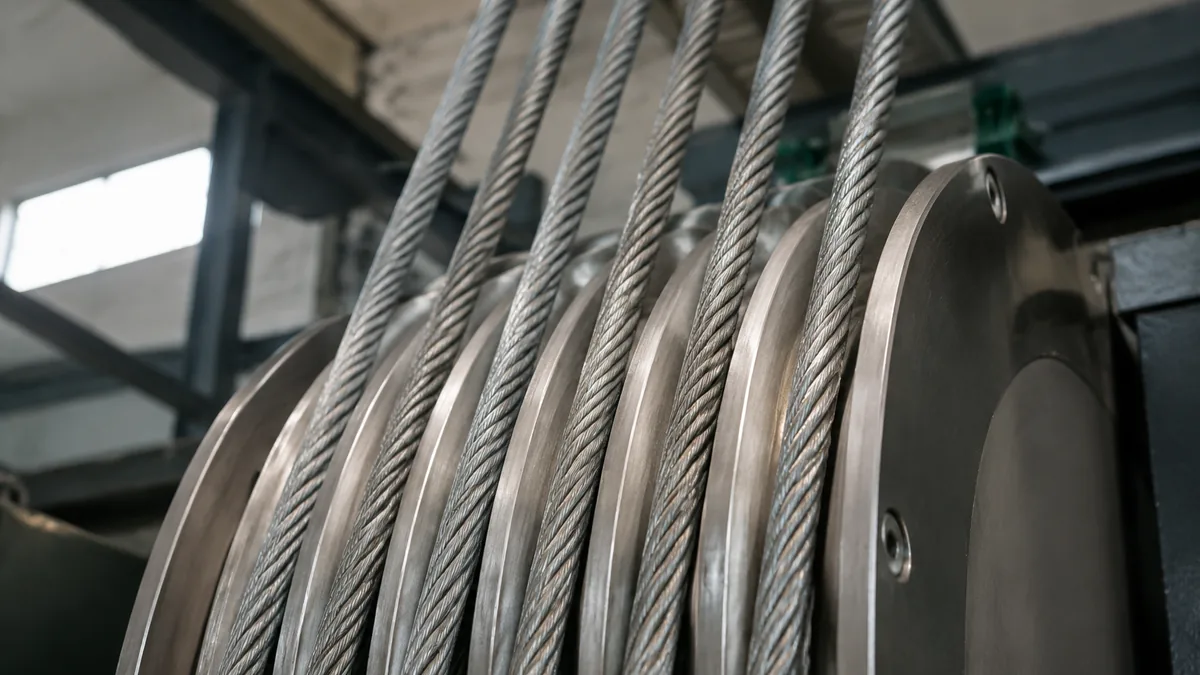
Application selection brief
Wire Rope Selection for Lifting and Hoisting Duty
Wire rope selection belongs to the lifting system. Equipment design, reeving, drum and sheave geometry, fleet angle, bending cycles, load spectrum, speed, environment, termination efficiency, inspection method, and discard rules can matter as much as nominal diameter. A qualified person and the equipment manufacturer should approve the final rope specification.
Selection inputs
Service conditions to define
- Equipment type, rope function, reeving diagram, number of parts, drum arrangement, sheave and drum groove condition, D to d ratio, fleet angle, and travel.
- Maximum and working loads, acceleration, shock, duty class, operating speed, bending cycles, layer winding, crushing risk, and required design factor under the governing rules.
- Indoor, outdoor, marine, mining, furnace, corrosive, abrasive, dusty, wet, or low-temperature exposure, with lubrication and maintenance constraints.
- Termination type, socket or attachment responsibility, rotation behavior, inspection access, discard criteria, and replacement procedure.
Failure review
Risks the specification must address
- Bending fatigue can accelerate when sheave diameter, groove profile, fleet angle, reverse bends, speed, or duty cycle do not match the rope construction.
- Drum crushing, crossover damage, birdcaging, rotation, core deterioration, abrasion, corrosion, lubrication loss, and broken wires require different controls and inspection responses.
- An incorrect diameter, construction, lay direction, core, grade, or termination can change system behavior even when a catalog MBL appears adequate.
- Using nominal MBL as a permitted working load without the governing design factor, termination efficiency, equipment rules, and qualified review can create a serious safety error.
Procurement matrix
Compare the service, material route, and evidence
| Duty concern | Construction feature to review | System checks |
|---|---|---|
| Repeated bending over sheaves | Flexible construction with wire size and core selected for fatigue duty | D to d, groove, fleet angle, reverse bends, speed, lubrication, and inspection |
| Drum crushing or multilayer winding | Compacted, steel-core, or crush-resistant route when equipment permits | Drum geometry, layer pressure, crossover, spooling, rotation, and manufacturer approval |
| Rotation-sensitive load or high lift | Rotation-resistant construction when required by the equipment design | Swivel permission, block stability, load, height, reeving, installation, and discard rules |
| Corrosive or outdoor service | Galvanized, stainless, coated, or lubricated route after strength and fatigue review | Environment, lubricant compatibility, inspection visibility, termination, and maintenance |
Acceptance package
Standards, inspection, and fabrication
Standards and inspection
- State the governing equipment and rope standards, exact construction, diameter, tolerance, lay direction, core, rope grade, finish, lubricant, and length.
- Specify measured breaking force or certificate requirements when applicable, wire tests, rope diameter, lay length, mass, construction verification, and traceability.
- Define end preparation and termination scope, proof or acceptance testing when required by the governing rules, and responsibility for socketing or assembly.
- Record inspection method, baseline measurements, lubrication, storage, installation tension, break-in procedure, discard criteria, and document retention.
Fabrication controls
- Confirm that cutting, seizing, socketing, swaging, splicing, or other termination work is performed under an approved procedure by the responsible specialist.
- Provide drum and sheave data, groove measurements, reeving drawing, fleet angle, and lay direction before confirming installation compatibility.
- Keep rope supply certification separate from complete lifting-device certification and operational approval.
Continue with the registered product owners
Compacted wire rope
Review the compacted rope owner while retaining equipment and duty limits.
Open ownerSteel strand
Review the strand owner and keep strand applications separate from running rope duty.
Open ownerConstruction and MBL reference
Organize construction, diameter, MBL evidence, and safety inputs before an RFQ.
Open ownerOrder-ready data
RFQ requirements
Send these fields together so technical review starts from one consistent specification.
Prepare an RFQ- 01
Equipment make and model, rope function, reeving drawing, drum and sheave dimensions, grooves, D to d, fleet angle, and travel
- 02
Maximum and working loads, duty class, speed, acceleration, shock, bending cycles, layers, governing standard, and required design factor
- 03
Exact construction, diameter, tolerance, lay, core, grade, finish, lubricant, length, and rotation requirement
- 04
Environment, termination, socketing responsibility, certificate, testing, inspection baseline, installation, and discard rules
- 05
Reel limits, pay-off direction, delivery destination, handling equipment, storage plan, and required date
Frequently asked questions
Can minimum breaking load be used as the working load?
No. Working limits require the applicable design factor, reeving and dynamic effects, termination efficiency, equipment rules, exact certified rope, and approval by the responsible qualified person.
When is rotation-resistant rope considered?
It may be considered when load rotation, lift height, reeving, and equipment design require it. Swivel use, block stability, installation, inspection, and manufacturer instructions must be reviewed for the exact construction.
What equipment data should be sent with a wire rope RFQ?
Send the equipment model, rope function, reeving drawing, load and duty data, drum and sheave dimensions, grooves, fleet angle, speed, travel, environment, termination, current rope designation, and governing rules.